

Abstract
This case examines a publicly shared private-message exchange after a disclosure of grief. The analysis does not decide whether anyone was right or wrong. Instead, it traces how language, relational proximity, and ambiguity shaped interpretation, expectation, and escalation. The purpose of this inquiry is to clarify what appears to be happening in the exchange. This allows readers to decide for themselves. They can decide whether the responses align with their own values and communication standards.
All identifying information has been removed. The analysis is limited to the text presented.
I. The Material
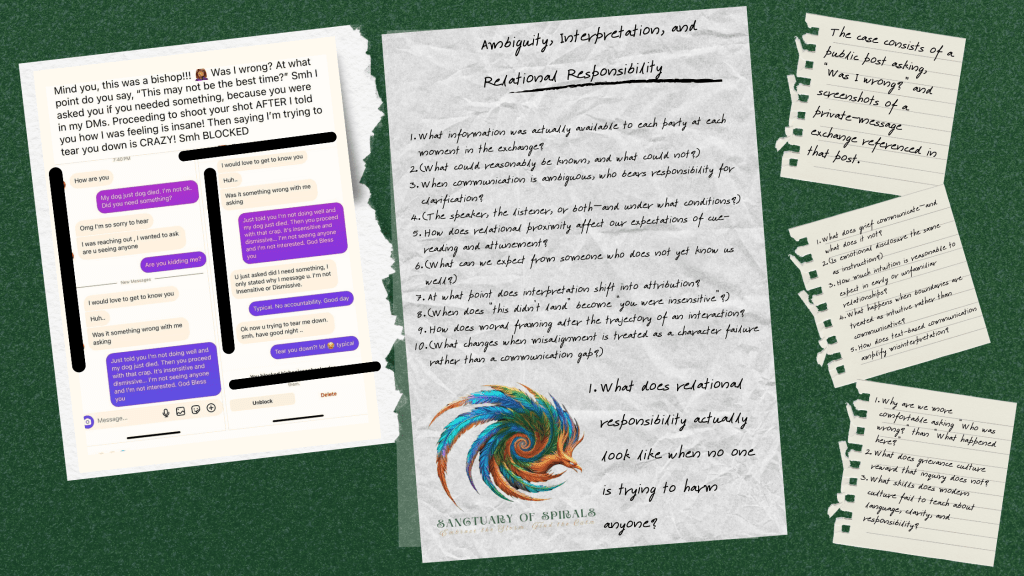
The case consists of a public post asking, “Was I wrong?” and screenshots of a private message exchange referenced in that post.
The exchange begins with a disclosure of emotional distress after a loss. The respondent is already present in private messages. They continue with a personal inquiry. They state an interest in getting to know the poster. The interaction escalates when the poster frames the timing as inappropriate and attributes insensitivity to the respondent. The respondent explains why they proceeded, referencing how they understood the earlier message. Contact is then terminated.
This inquiry does not examine intent or character. It examines language, sequence, and interpretation.
II. Grief as Context, Not Instruction
The disclosure of grief communicates an internal state. It doesn’t, on its own, communicate preference.
People respond to grief differently. Some want solitude. Others want conversation, distraction, or connection. There is no universal relational response to distress, and absent explicit instruction, responses must be inferred.
This distinction matters because inference is not misconduct. It’s a response to incomplete information.
III. Ambiguity and Meaning-Making
At the center of this exchange is an ambiguous phrase: “Did you need something?”
Linguistically, this phrase can work in more than one way:
- as a boundary-setting prompt requesting purpose, or
- as an opening indicating availability to continue.
Both interpretations are plausible. The wording does not clearly close or open the interaction. Meaning must thus be supplied by the reader.
When ambiguity exists, responsibility for interpretation is shared. Clarity is the only mechanism that reliably resolves interpretive gaps.
IV. Relational Proximity and Cue Interpretation
The respondent states that they would like to get to know the poster. This signals limited relational familiarity.
Interpretive accuracy increases with relational proximity. When people share history, they develop a patterned understanding. This includes how distress is expressed, how boundaries are typically set, and how timing is usually handled. In early or unfamiliar relationships, those shared reference points do not yet exist.
Expecting nuanced cue-reading from someone with limited relational context is challenging. It places interpretive responsibility on information the relationship itself has not yet produced.
This does not negate the importance of care. It clarifies the conditions under which care can reasonably operate.
V. The Expectation of Knowing Without Being Told
In the public framing of the exchange, the poster poses a question. “At what point do you say. ‘This may not be the right time’?” The implication is that the respondent should have recognized and honored a boundary.
This raises a prior question the case itself must tackle. How can a boundary be respected if it has not been laid?
Expectation of recognition assumes access to information. In this exchange, that information was not explicitly provided. The respondent is assigned responsibility to decide that the timing was inappropriate. There was no clear signal to base that decision on.
This creates a familiar relational bind: you should have known, without specifying how knowing is possible.
This inquiry doesn’t argue that boundaries must always be verbalized, nor that intuition has no role in relationships. It asks what information is reasonably available in a given exchange. It also questions whether accountability is placed on interpretation instead of communication.
VI. Escalation Through Attribution
The relational snag doesn’t occur when the first signal is missed. It occurs when misalignment is reframed as moral failure.
Ambiguity is sometimes interpreted as insensitivity. When explanation is read as a lack of accountability, the exchange shifts. It moves from navigation to opposition. At that point, explanation functions defensively, not because it is dismissive, but because the frame has changed.
This is an observation about interactional structure, not intention.
VII. What This Case Makes Visible
This case doesn’t show wrongdoing. It demonstrates how:
- ambiguity invites projection,
- interpretation hardens into attribution, and
- moral framing accelerates rupture.
The issue isn’t whether the response was appropriate. Instead, it is whether the expectation placed upon the respondent was structurally achievable. This depends on the language and relational context available.
Closing Inquiry
Rather than asking whether someone was wrong, this case invites a different question:
What responsibility do we carry for clarity when we are vulnerable, and how does that responsibility shift with relational distance?
This inquiry does not answer that question. It makes the structure visible so readers may decide for themselves.
 Sanctuary of Spirals
Leave a comment